
Somebody valued your business. Now ask them this.
What to ask anyone who puts a number on your business, and what a good answer and a thin answer sound like.

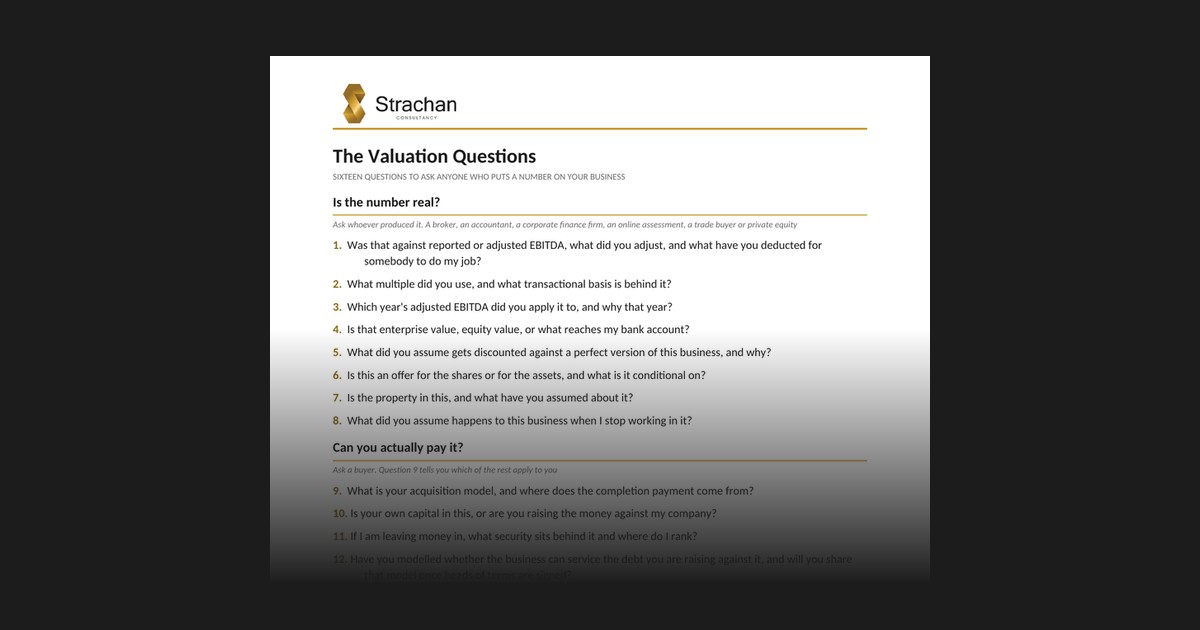
Somebody has put a number on your business. A broker, an accountant, a corporate finance firm, a free online assessment, or a trade buyer or private equity firm who has approached you directly. They are all valuing your business, and Part 1 applies to all of them.
Before you ask anything about the number, understand how the person who gave it to you is paid. A broker is usually paid mainly on completion, and many also charge a fee up front. Either way, the incentive at the pitch is to win the instruction, and that means optimism. Your accountant is usually paid for time or a fixed fee, has no transaction incentive and often no transaction experience either. A buyer is paid by the gap between what your business is worth and what they persuade you to accept. None of that makes any of them dishonest. It means the number arrives with a direction of travel attached, and you should know which way it points.
None of the questions below are clever. They are the ones the person giving you the number expects nobody to ask.
How a business valuation is built
There is more than one way to value a company. An asset-based approach values what the business owns. A discounted cash flow values what it will produce in future, discounted back to today. For a private trading company of your size, neither is usually what happens.
What happens is that somebody takes your profit, adjusts it, multiplies it, and then makes deductions. This article assumes that method, because it is almost certainly the one you will be shown.
The chain runs in three steps, and most of the confusion in a sale comes from treating them as one number.
- Step 1. Adjusted EBITDA × a multiple gives Enterprise Value, which is what the business itself is worth, however it happens to be financed. Lenders and shareholders share it between them.
- Step 2. Enterprise Value, less debt and debt-like items, plus cash, adjusted for working capital gives Equity Value, which is what your shares are worth. Deals are usually done cash-free and debt-free, which means the business is handed over with the borrowings cleared and the surplus cash taken out, and the price is adjusted accordingly. Note that debt here is wider than borrowings. Amongst other items, it commonly includes overdue tax, pension deficits, unpaid pension contributions, deferred consideration owed on earlier deals, and deferred revenue where you have taken the cash but not yet delivered. Which items count is itself negotiated.
- Step 3. Your share of the Equity Value, less your adviser fees, less the tax on your gain, less anything held back in escrow, less anything deferred or dependent on future performance, less any part taken in shares rather than cash gives the cash you keep from completion day. The escrow and deferred amounts may follow later, but only if their conditions are met.
One more thing worth knowing before you start. The same business is worth different amounts to different buyers. A buyer who can strip out duplicated cost, or push your product through channels they already own, can pay more than one who cannot, and still make the same return. That is why who is buying matters as much as what the multiple is.
Adjusted EBITDA: an illustrative add-backs schedule
This is what you should be asking to see, line by line. The figures are for a fictional £6.2m turnover manufacturer and are not a comment on any real business.
Three things to notice. The add-backs are yours to argue for. The deduction at the bottom is the buyer's, and it must be a full cost to company figure rather than a salary, evidenced against real packages for that role in your sector and region, and practical for the hours the job actually takes. Both sides of this have to be on the same basis, full employment cost, or you are comparing different things. And the arithmetic cuts both ways: if the buyer disallows the £70,000 relocation as not genuinely non-recurring, adjusted EBITDA falls to £730,000, and at a multiple of five the price falls by £350,000.
Part 1: Is the number real? Eight questions for whoever valued your business
Applies to whoever produced it: broker, accountant, corporate finance firm, online assessment, trade buyer or private equity
1. “Was that against reported or adjusted EBITDA, what did you adjust, and what have you deducted for somebody to do my job?”
Why it matters. Everything downstream is a multiple of this figure, so a pound of difference here becomes a pound multiplied by whatever the multiple turns out to be. The adjustments schedule is where a valuation is quietly built. A good adviser will show it to you without being asked. A buyer trying to tilt the negotiation their way often will not, because every line in it is a line you can argue with.
A good answer. The schedule above, or something like it. Every line stated, every add-back explained, and the replacement management deduction evidenced rather than assumed.
A thin answer. "It was on the profit figure." "Around three times profit." "I don't have the breakdown with me."
What to press on. Watch what is being deducted, and on what basis. The cost of somebody doing your job to keep the business where it is today is a fair deduction, and it is a cost to company figure, not a salary. The cost of board fees, management charges or a team hired to grow the business is not, because that is the buyer's cost of executing their own plan. You are being bought in your current state at your current profit.
2. “What multiple did you use, and what transactional basis is behind it?”
Why it matters. A multiple comes from evidence or it comes from a rule of thumb, and those produce very different numbers.
A good answer. At your size, published deal prices are scarce, so do not expect a database printout. A good answer is a practitioner one: which deals they have actually acted on in your sector in the last year or two and the range they saw, or, if they were not involved, which comparable deals or published benchmark they relied on and how closely those businesses match yours. Either way, with an honest acknowledgement that the data at this size is thin.
A thin answer. "Four to six times is what the sector does." A range for a sector is not a valuation of a business. Relying on deals they were not part of, or on a published benchmark, is normal, and at this size it is often all anyone has. The test is whether they can name the source, say how closely those businesses match yours on size, products and customers, and explain why your number sits where it does in the range. If they cannot, the multiple is a guess with a decimal point.
What to press on. One turn of multiple equals one times your adjusted EBITDA. On £800,000 of adjusted EBITDA, every turn is £800,000 of enterprise value. That is why the question of whether you are a four or a six matters more than almost anything else you will discuss.
3. “Which year's adjusted EBITDA did you apply it to, and why that year?”
Why it matters. The same multiple applied to last year, to a three-year weighted average, or to a forecast gives three different answers. If your best year was two years ago, somebody wanting to please you will find it.
A good answer. A stated basis with a reason. Commonly a weighted average across three years with the most recent weighted highest, and an explanation of why that suits how you trade.
A thin answer. A number that happens to sit on your best year, with no reason given.
What to press on. Ask for the same multiple applied to each of the last three years and to the weighted average. Four figures on one page. The spread between them is the range you are actually negotiating in.
4. “Is that enterprise value, equity value, or what reaches my bank account?”
Why it matters. These are three different figures and owners collapse them into one. Enterprise value is what the business itself is worth, priced as if it had no borrowings, no surplus cash and a normal level of working capital. That is what cash-free, debt-free means. Equity value is what your shares are worth once the actual debt is deducted, the actual cash added back, and any shortfall or excess of working capital against that normal level adjusted for. Net proceeds are what you keep after fees, tax, escrow and anything deferred.
A good answer. Enterprise value stated clearly, and the mechanism for getting from it to equity value: what they are treating as debt and debt-like, and what level of working capital they expect to be left in. Fees and tax are your costs, not theirs, so do not expect them to calculate your net proceeds. That is your accountant's job, and the point of asking is so you never confuse their number with your outcome.
A thin answer. "That's the value of the business." It is. It is not what you receive.
What to press on. Two things. There are no standard definitions of cash, debt or normal working capital, and they are rarely pinned down properly in an offer letter, so the definitions themselves get negotiated and that is where money moves. And on working capital, expect only a blanket statement before heads of terms. The level usually gets set during financial due diligence by the buyer's accountants, after you are already in exclusivity. In a seasonal business that matters enormously, because your stock and debtors in February look nothing like July. Know your own working capital profile across a full year before you get there, because you will be arguing with their analysis rather than producing your own.
5. “What did you assume gets discounted against a perfect version of this business, and why?”
Why it matters. Every valuation is a perfect business discounted for what is actually there. Ask for the discounts and the reasoning and you have their whole case in front of you, in a form you can argue with.
A good answer. Two or three headline reasons why this is not a premium-multiple business in their view. You are not going to get a weighted schedule at this size and you should not expect one, but you are entitled to know what is holding the number down.
A thin answer. "Nothing specific, that's just where the market is." That means either they have not looked, or they have and would rather you did not see it.
What to press on. Customer concentration is usually the largest of these and it does not always work as a discount. Above a certain level a proportion of buyers will not price the risk at any multiple, so what it costs you may not be turns off the price. It may be the length of the buyer list. That is practitioner judgement rather than published data.
6. “Is this an offer for the shares or for the assets, and what is it conditional on?”
Why it matters. Two different questions, both of which change what the number means. On a share sale you sell the company. On a sale of business and assets the company sells its business and assets, and you are left holding a company with cash in it which you then have to extract. The tax outcomes are materially different. At this size, sales of healthy trading companies are predominantly share sales, because the company keeps its contracts, leases, licences and accreditations, so, change of control clauses aside, none of them has to be transferred or applied for again. In food and drink that matters more than most. Staff move either way: on a sale of business and assets they transfer to the buyer automatically under TUPE, after a formal duty to inform and consult. A buyer pressing instead for a purchase of business and assets usually has a specific reason, and it is worth understanding what that reason is. Separately, an offer subject to due diligence, funding and board approval is worth considerably less than one that is not, and owners routinely treat the two as the same thing.
A good answer. A clear statement of which is proposed and why, and a list of what the offer is actually subject to, with an indication of how long each condition will take to clear.
A thin answer. "We'd structure that later." The structure is not a detail, it is one of the largest single influences on what you keep. And no explanation of why business and assets is preferred over shares.
What to press on. The tax consequences are a question for your accountant rather than for the buyer, but you should know which is on the table before you agree anything. On a share sale you are the seller, and Business Asset Disposal Relief may apply to your gain: 18% on gains from 6 April 2026, on up to £1m of qualifying gains across your lifetime. On shares, the conditions normally include holding at least 5% of the shares and voting rights, and being an officer or employee of a trading company, throughout the two years before the sale. On a sale of business and assets the seller is the company, not you. The company pays corporation tax on the profit it makes on the sale, and you are then left to extract what remains, which is a second tax event. Relief may become available to you at that point, for instance on a capital distribution in a liquidation, but that turns on how it is done and on anti-avoidance rules. Take the specifics to your own adviser. The point here is only that structure and price are not separate questions.
7. “Is the property in this, and what have you assumed about it?”
Why it matters. If your company owns its premises, the freehold is usually inside the deal whether you intended it to be or not, and it may be a large part of the number you have been given. Buyers vary enormously. Some will pay for it, some discount for having capital tied up in bricks, and some do not want it at all.
A good answer. A clear statement of whether the property is included, at what value, and whether they would rather buy the trade with a lease already in place.
A thin answer. Silence, or a single number that quietly includes your building without saying so.
What to press on. If the freehold sits inside the company and you would rather keep it, separating the two is a decision with a long lead time and real tax consequences, and it is one for your accountant. It is also among the clearest examples of something that is straightforward three years out and expensive or impossible in the final twelve months. And if a lease is going to be granted, do this arithmetic first: the rent reduces the profit the multiple is applied to, so every pound of annual rent above market costs you that pound multiplied by the multiple, in price, against a pound a year of income. Work out where your own break-even sits before anybody agrees a figure.
8. “What did you assume happens to this business when I stop working in it?”
Why it matters. You are the thing being sold least often and priced most heavily. A buyer is not acquiring your relationships, your knowledge of the trade or your ability to hold it together. What they are acquiring is what remains once you leave.
A good answer. A specific view on what your role costs to replace and what struggles in the first six months without you.
A thin answer. "That's factored in." It usually is not, or it is factored in twice.
What to press on. Watch for double counting. If a replacement salary has come off adjusted EBITDA and a lower multiple has also been applied for owner dependency, you are paying for the same problem twice.
Part 2: Can you actually pay it? Eight questions to ask a buyer
For a buyer only. Which of these matter depends on how the purchase is being funded, and question 9 is what tells you. A buyer using their own reserves faces a very different set of these from one raising debt against your business
9. “What is your acquisition model, and where does the completion payment come from?”
Why it matters. You are being asked to sell to a structure, so you are entitled to see the structure. There is a large difference between a buyer with committed funds and a buyer with an intention.
A good answer. A capital stack, stated plainly. How much equity and from whom, how much debt if any and from which lender, and how much deferred and over what period.
A thin answer. "We have funding in place." That sentence does a great deal of work and means nothing on its own.
What to press on. A funded buyer answers this in thirty seconds, and the speed of the answer is itself information. It also decides which of the questions below apply to you: a buyer paying from their own reserves carries none of the affordability risk in question 12, and if no lender is involved at all your position under question 11 is far stronger than it would otherwise be.
Then ask them to evidence it, in two stages rather than one. Before heads of terms, ask only for written confirmation. Not bank statements. A line in an email stating the source of the money, whether that is their own reserves, a named facility or a committed investor, and confirming it is available and not committed elsewhere. Any real buyer sends that in five minutes, and you are only asking them to repeat in writing what they have already told you. A buyer who will not is telling you something for nothing.
Actual evidence belongs inside the heads as a dated condition: a redacted statement showing the balance, a lender's term sheet, or an investor's commitment letter, delivered within a stated number of working days. Attach exclusivity to it, so that either exclusivity does not begin until the evidence arrives, or it falls away if the evidence does not. That is the same mechanism as question 12, so one rule covers both kinds of buyer: whatever the funding route, the heads carry a dated funding evidence condition with exclusivity hanging off it.
Two practical points. Make the request procedural rather than personal. "My adviser requires this before I take the business off the market" is impersonal and difficult to argue with. The same request phrased as doubt about the individual ends conversations. And not every deal needs any of this. If you are selling to a trade buyer you have known for fifteen years, for cash, with nothing left in, demanding a funding evidence protocol would be absurd. It matters where the buyer is unknown to you, where the structure is complicated, or where any part of the price is deferred.
10. “Is your own capital in this, or are you raising the money against my company?”
Why it matters. There is a world of difference between a buyer risking their own money alongside yours and a buyer using your balance sheet, your debtor book and your assets to fund the purchase of your own business.
A good answer. A stated equity contribution and where it comes from. If investors are involved, who they are and whether they have committed or merely expressed interest.
A thin answer. Evasion, or a change of subject to how much they admire what you have built.
What to press on. If the money is being raised against your company, the next two questions decide whether you are paid.
11. “If I am leaving money in, what security sits behind it and where do I rank?”
Why it matters. This is the most important question here. If part of your price is deferred, whether documented as a simple obligation or as loan notes, or made contingent on future performance through an earn-out, you are lending money to the person who has just bought your business. Keep that separate in your mind from equity you hold on to. Retained equity is where you keep some of your shares in your own company alongside the buyer. Rolled equity is where you exchange some of your shares for shares in the buying company. Neither is deferred price. Both are you choosing to stay invested alongside the buyer, and that is a different decision with a different risk.
A good answer. A clear answer on ranking, and on what is actually being offered. Ask which of these is on the table: a charge over the shares of the buying company or of your own company, a charge over its assets, a personal guarantee from the buyer, a guarantee from another company in their group, or an amount held in escrow by solicitors. Any of those is a real answer. "It is documented as a loan note" is not. And a personal guarantee is worth whatever the person giving it is worth, so it is fair to ask what stands behind it.
A thin answer. "It's all in the loan note instrument." That describes the paperwork, not your position. There are three positions and only one of them is comfortable. Unsecured, where you rank behind every secured lender and behind the preferential creditors, which include HMRC for some taxes, alongside the trade creditors. Second-ranking, where you hold security but a bank holds a first-ranking debenture over the company and its assets, so it is repaid in full before you receive anything. Or first-ranking, where you are effectively the bank. Being told you have security is not the same as being told you will be paid, and the difference between second and first ranking is usually the difference between recovering something and recovering nothing.
What to press on. First establish whether there is a lender at all. If the buyer is funding from their own resources and the only money owed is yours, you are in a materially stronger position than most sellers who leave money in, because nobody ranks ahead of you. That is worth settling early, because it changes what you should be prepared to accept. Then work out what proportion of the total is cash at completion and what proportion depends on the business surviving its new ownership. If security is offered, ask whether it is over the shares or over the assets, and where any lender ranks against it. Understand what a charge over shares actually gives you once a lender is involved. If a bank holds a first-ranking debenture over the company's assets it will require you to sign a deed of priority or subordination agreement, and that will normally stop you enforcing without the bank's consent, or until an agreed standstill period has passed, while the bank is still owed. Even holding first-ranking security over the shares, you may be unable to act, and if you did take the company back you would take it back with the bank's charge still over everything inside it. Security over shares is worth having. It is not the protection it sounds like once a lender is in front of you. If nothing tangible is offered, or what is offered sits behind a bank, ask whether you would lend that amount unsecured to this person. That is the decision you are being asked to make.
12. “Have you modelled whether the business can service the debt you are raising against it, and will you share that model once heads of terms are signed?”
Why it matters. This one only applies where debt is being raised against your business and serviced out of its own future cash flow, which is the usual arrangement but not the only one. If the buyer intends to service borrowings from elsewhere, or to inject capital to cover repayments, ask them to say so and to say where that money comes from, because it changes the risk entirely. Where the business is expected to carry its own acquisition debt: if the cash it generates cannot cover the repayments, the deal dies at the funding stage. That normally happens after heads of terms, after exclusivity, and after the first rounds of due diligence, when both sides have already run up adviser fees. So you do not only lose ninety to a hundred and twenty days with the business off the market. You have paid legal and accounting costs for a transaction that was never affordable, and your staff have spent a quarter noticing.
A good answer. A named lender who has seen this specific deal rather than one who lends in general, an indication of appetite, and confirmation that a preliminary affordability model exists and works on a debt service coverage basis. That is a low bar, and a buyer who cannot clear it has not started.
A thin answer. "We'll model that once we're agreed in principle," or an assurance that it is affordable with nothing behind it. What often happens next is that financiers are appointed after heads are signed, the model does not work, and the buyer returns to re-trade the price. The deal does not collapse. It gets renegotiated downwards, and by then you have been off the market for two months and have already paid advisers.
What to press on. Do not ask to see the model before heads of terms. Most buyers will refuse and refusing looks reasonable at that stage. Instead, make the sharing of it a condition inside the heads, with a date attached, so exclusivity falls away if funding evidence does not arrive. That costs nothing to ask for and it is normal. And if you are taking a loan note, remember the same cash has to service your note after the bank has been paid, so you are one of the lenders and entitled to see the arithmetic once you are committed.
13. “Who is going to run this business after completion?”
Why it matters. If there is no operational answer then either you are staying longer than you think, or the business is going to somebody not yet identified. Both threaten anything you have left in, because you are only paid if the business survives.
A good answer. A named individual, a team coming across, or a search already under way with a firm instructed.
A thin answer. "We'll recruit once we complete." That is a search starting on day one, and in my experience that is commonly four to seven months from brief to a managing director actually in post, during which somebody has to run the company.
What to press on. Ask this even if you are taking all cash. Ask it twice if you are not.
14. “What does the first hundred days look like?”
Why it matters. It tells you whether there is a plan or an intention. A buyer who has thought about integration has thought about what they are buying. One who has not is improvising with your business and, if you have money left in, with your money.
A good answer. Something specific on systems, reporting, people, customers, and what changes in what order.
A thin answer. Generalities about synergies and growth.
What to press on. Offer your own view. Most buyers never ask the seller how integration should be handled, which is a strange omission given you are the only person who knows.
15. “When would you expect to meet my management team?”
Why it matters. The most contentious timing question in any sale, and better raised in week one than fought over in week eight. The buyer wants them early, for continuity and because they will be the ones executing the plan. You want it late, because once your people know, they cannot unknow it.
A good answer. A stated position and a willingness to tie timing to progress. A workable middle is once heads of terms are signed, initial due diligence has been conducted, and, where funding is being raised, an initial funding term sheet has been received. Where the buyer is using their own money, confirmation that it is available and not committed elsewhere.
A thin answer. An expectation of early access with nothing offered in return.
What to press on. Every step towards your people should cost them a step towards certainty.
16. “Can you introduce me to somebody you have bought a business from before?”
Why it matters. If you are accepting this buyer's loan note you are making a credit decision about them. You would take a reference before lending a stranger money. This is that, with more zeros.
A good answer. A name, a number, and no hesitation. A buyer who has treated previous sellers well will offer it before you ask. Ask two more things while you are there: how many acquisitions they have completed, and how many they have withdrawn from after heads of terms were signed. The second number is the more revealing.
A thin answer. Reluctance, or an explanation of why it would not be appropriate. There is no reason it is not appropriate.
What to press on. The cheapest piece of diligence available to you, and almost no seller does it.
What to do with the answers
You are not trying to catch anybody out and you are not trying to reach your own number. You are trying to find out whether the figure in front of you rests on anything.
None of this replaces having your own adviser. You will appoint one, and you should. These are the questions worth asking before you do, while it still costs you nothing.
If most of these produce specifics, you are dealing with somebody serious, and the number is a reasonable starting point for the business as it stands today.
If most of them produce generalities, you have been given a marketing number. That is worth knowing before you accept it, and before you make any decision that rests on it.
Two things this does not cover. The first is the list you get from question five. That list is the starting point for a different exercise, and it works on both halves of the equation rather than one. You can change the earnings figure the multiple is applied to, and separately you can change the things holding the multiple down, and the two interact. Which of those can be moved in the time available, which cannot be moved at all, and which are not worth the effort, is a different question from what the business is worth today.
The second is what happens after a price is agreed. Heads of terms through to completion is where six-figure sums move, on warranties, retentions, the working capital measurement, the debt and cash definitions, and how any earn-out is designed. It is barely taught anywhere and it is not covered here.
Strachan Consultancy works with owners of UK food and drink manufacturers and wholesalers who are three to five years from selling. Mark Strachan has spent twenty-six years in the sector as an operator, a founder and a buyer. He has built and sold three businesses, run a hundred-strong export packing operation, and between 2021 and 2022 acquired six food, drink and logistics companies across four transactions, with combined revenue at acquisition of around £81m. The questions above are the ones he was asked, and more often the ones he was not.
Tax rates and thresholds stated in this article are correct at 30 September 2026 and should be confirmed with your own adviser before you rely on them. This article is general information, not advice.
Keep reading
We don't have any articles that match that search. Keep browsing or return to the home page.