Start with the number you need, not the number you are offered
Most owners start with what the business might fetch. Start instead with what the sale has to put in your bank after tax and costs, whether it is paid on completion or later, and work back to the price your shares must reach. The gap between the two is the real problem, and it is not the buyer's to solve.


Stephen has run his sauces and condiments business for twenty-two years. This autumn a buyer got in touch. Over a few weeks they swapped accounts, walked round the site, and the buyer proposed £1.5m for the business, with the sale to go through next year.
For a week Stephen felt rich. Then, over dinner, his wife Anne asked him a simple question: is it enough?
He did not know. In twenty-two years he had never worked out how much the two of them would need to live on for the rest of their lives. He did not know how much of the £1.5m would actually reach their bank either. He had never done the sum, and did not know where to start.
So he went to an adviser who specialises in exit planning for food and drink businesses, preparing owners in the years before they go to market, with his accountant on the tax. Together they broke it into questions and took them one at a time.
First, how much of the £1.5m would reach their bank. The £1.5m was for the business as if it had no debt. From it the buyer would take the £150,000 bank loan and £40,000 of tax and customer deposits the company owed, and add back £60,000 of spare cash. Working capital was at its normal level, so nothing changed there. That left £1,370,000 for Stephen's shares. Out of that came £150,000 of fees for selling, then the tax on what was left. What would reach the bank: about £957,000.
For a week Stephen felt rich. Then, over dinner, his wife Anne asked him a simple question: is it enough?
Second, how much they needed: the mortgage to clear, help for the children, and an income for the rest of both their lives, with prices rising and perhaps care at the end. That came to £1.39m.
The offer was about £434,000 short of what they needed. To close it, the buyer would have had to pay about £1.94m for the shares: £570,000 more than the shares were worth under the offer.
Most owners never do this sum. Ask what the business is worth and they will give you a figure, usually from an accountant's comment, a broker's pitch or a rival's sale. Ask how much they need from it and almost nobody knows.
The gap is not the buyer's problem. A buyer pays what your business is worth to them, not what you need. Closing the gap is your job, and three years out you still have time to do it.
Below is a summary of the method his adviser took them through. It shows the shape of the sum, not every detail a full plan covers. Use it to make a first attempt at your own figures. A first attempt is usually what shows an owner how much they did not know.


Two numbers, and which is which
There are two numbers here, and they are easy to mix up.
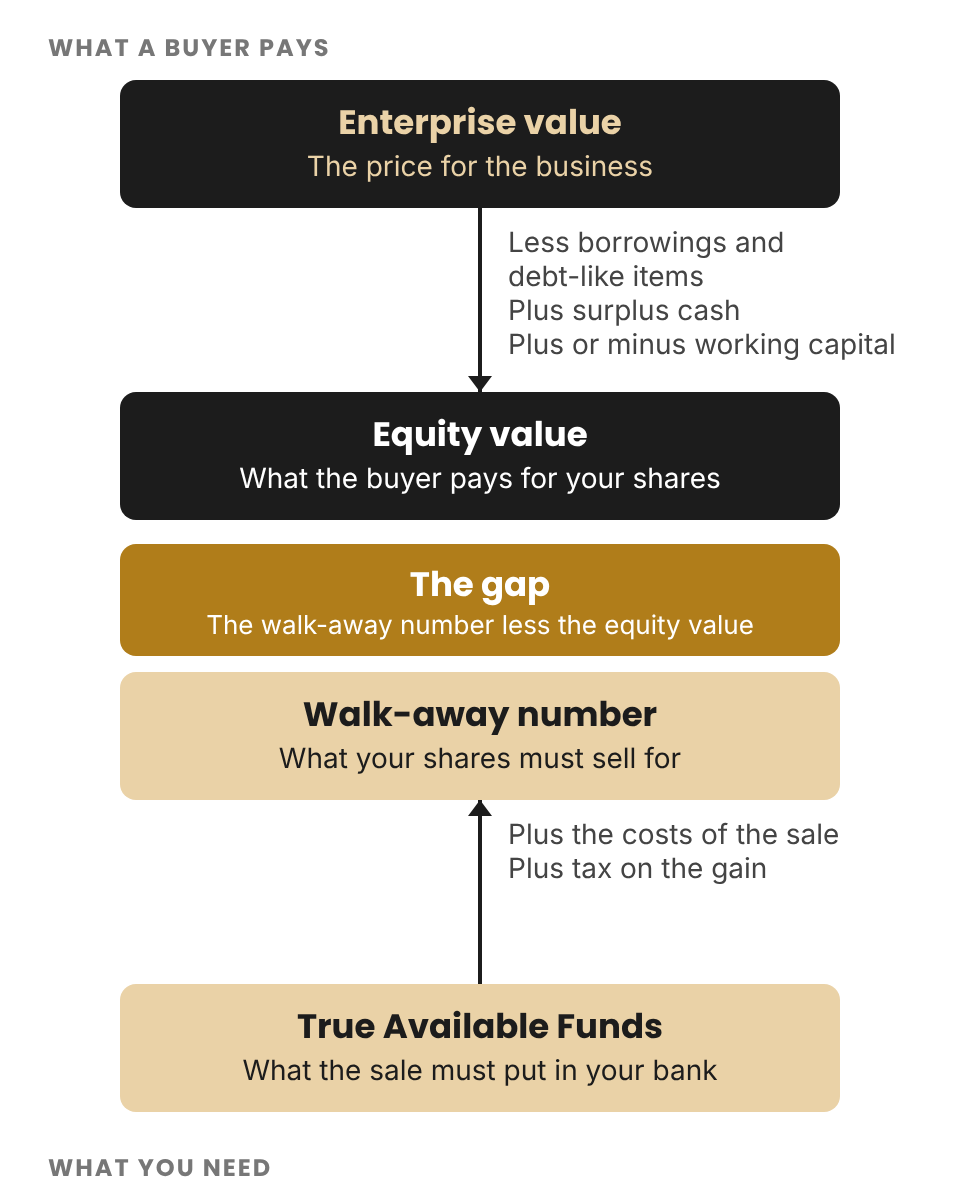
What you need. The money the sale has to provide to fund your future: everything the sale must put in your household's bank, whether on completion day or later, after the tax on the sale and after the costs of the sale have been paid. We call it True Available Funds. Nobody else can decide it for you, because it rests on how you want to live.
The price your shares must reach. What a buyer has to pay for all the shares, however and whenever it is paid, so that once the costs of the sale and the tax are paid, you are left with what you need. We call it your walk-away number. It is the bigger of the two numbers, because the tax and the costs come out of it. The costs of the sale sit here because the sellers pay them out of what the buyer pays for the shares.
That share price is not the headline figure a buyer quotes. A buyer starts with a price for the business as if it had no debt, no spare cash, and a normal level of working capital to run it. In the trade this is called cash-free, debt-free. The buyer then adjusts it:
Less borrowings, and debt-like items: money the company owes that is not a bank loan, such as corporation tax due, and often cash customers have paid for orders not yet delivered.
Plus surplus cash: cash above what the business needs to trade day to day.
Plus or minus working capital. Working capital is the money tied up in day-to-day trading: what customers owe you, the stock you hold and costs paid in advance, less what you owe suppliers and costs you have run up but not yet been billed for. Bank loans and corporation tax owed are not part of it. Bank loans come off the price as borrowings, and corporation tax owed as a debt-like item. In food and drink it rises and falls with the seasons, so a buyer agrees a normal level, usually worked out from the monthly figures across a year, and expects that to be left in the business. Depending on how the deal is structured, if there is less than normal, the difference comes off the price, and if there is more, it can be added.
What is left is the price for the shares. That is the figure your walk-away number is measured against. In this article we assume the whole price is paid in cash when the sale completes. Money paid later is one of the traps further down.
1What has to be cleared
Start with what the sale has to pay off before anything else.
Your mortgage at the date you expect to sell, not today's balance. Ask your lender for the projected figure.
Other secured borrowing, personal loans, credit cards and car finance you would clear before you stop working.
Personal guarantees. If you have guaranteed the company's bank borrowing, the guarantee is normally released when that borrowing is repaid at completion, but only if the lender agrees, so ask. A guarantee you have given for anybody else is not released by selling your company. Set aside what it could cost you.
2The lump sums
Next, the one-off amounts you plan to take out of the sale. Work on the house you will retire in. Deposits for your children's homes. Gifts. A car. A thank-you to the staff who helped build the business. Money set aside to invest, or to start something new.
Count each one once. It is easy to count the family twice: once as a deposit for a child, and again as money you want to leave them.
One point for a tax adviser before you sell. Shares in an unlisted trading company can qualify for Business Relief from inheritance tax: 100% on up to £2.5m of qualifying business and agricultural property combined, for deaths on or after 6 April 2026, and 50% above that. A spouse or civil partner's unused allowance can pass to the survivor. The shares must have been owned for at least two years. Cash does not qualify. Once your shares become cash, money you plan to leave your family may face inheritance tax that the shares would not have. If you reinvest the money in another business that qualifies, relief can carry on, subject to conditions (Inheritance Tax Act 1984, section 107).
3Stephen and Anne's forecast, decade by decade
This is the hardest part, and the one owners most often guess. You are forecasting the rest of your life, in money, a year at a time.
Work in today's money, and assume your savings, after any tax on them, only keep pace with inflation. That is the cautious choice, and it means you do not have to guess what prices will do.
Then picture each stage and give it a figure, after tax. Here is how Stephen and Anne did it:
Next, list every income that carries on without the business, and the age it starts, and take the tax off it, because your spending is after tax. The full new State Pension is currently £241.30 a week, about £12,548 a year, for someone with 35 qualifying years of National Insurance. It is paid from 67 for anyone born between 6 March 1961 and 5 April 1977. Check your own forecast on GOV.UK. Private and workplace pensions can be drawn from 55 now, rising to 57 on 6 April 2028. Rent from property you own personally counts too.
Stephen and Anne both have a full National Insurance record, so both will get the full State Pension from 67. Stephen also has a pension of £15,000 a year before tax. After income tax at today's rates, he keeps about £14,500 a year at first, and about £24,550 once his State Pension starts. Anne's State Pension sits within her tax-free personal allowance.
For each year, take what you spend, less the income coming in that year. Add every year up to the age the money must last to, counted on the younger of you so it lasts for whichever of you lives longer. Stephen and Anne chose Anne's 92nd birthday. Pick an age you are unlikely to outlive, not the average. The ONS life expectancy calculator shows your chances of reaching each age. Added up, the income they need from the sale came to £980,815.


4A margin, less what you already have
Then add a margin for the years that do not go to plan: the roof, the health scare, the child who needs help twice, prices rising faster than you expected. An amount you would sleep easily with.
Take off the cash and investments you already hold and will put towards this. Not your pensions, and not your home.
What is left is what you need: your True Available Funds.
Stephen and Anne: what they need
Stephen owns all the shares in his business. If he accepted the offer, the sale would go through in 2027, after 6 April, when he will be 62 and Anne 60. Their figures are an illustration, not a benchmark.
From what they need to what the shares must sell for
Now work backwards. Two things sit between what a buyer pays for Stephen's shares and what lands in his bank: the costs of the sale, and tax.
Assumes Stephen is a higher-rate taxpayer and his shares cost him nothing, and ignores the £3,000 annual exempt amount.
Two assumptions sit behind these figures, and each is checked against the rules:
The costs of the sale, £150,000, cover the adviser who runs the sale, the lawyers and the accountants, plus VAT on their fees. Stephen pays these fees as an individual selling his own shares, not as a business, so he has no way to reclaim the VAT. Only VAT-registered businesses can reclaim VAT, and only on costs of their own business. The company cannot normally reclaim it for him either, because the fees are for selling Stephen's shares, not for running the company. The figure is an assumption for the example, and fees vary widely. The costs are taken off the gain before tax is worked out.
The tax. Stephen owns all the shares, works in the business as a director, and has never claimed Business Asset Disposal Relief before, so his full lifetime limit is available. The first part of his gain is taxed at 18%, and the rest at 24%, the higher rate of capital gains tax. The government has announced that for sales on or after 6 April 2027 the relief will cover only the first £500,000 of lifetime gains, down from £1 million. It is not yet law. The sale would go through after 6 April 2027, so £500,000 is his limit.
A new Founders' Relief, at 10%, has been proposed for sales from 6 April 2027. It is aimed at fast-growing companies with turnover of at least £10m, at least 15 full-time staff and rapid growth or heavy research spending, and it is still out to consultation. Stephen's business does not qualify, and most owners reading this will not either.
The same sale a year earlier
Had Stephen sold before 6 April 2027, his relief would have covered £1 million of gain instead of £500,000. His shares would have needed to sell for £1,901,073: about £39,500 less, with nothing about the business different.
How the shares are held matters too. Each qualifying shareholder has a lifetime limit of their own. Whether holding shares jointly would help, and whether the conditions are met, is a question for a tax adviser well before a sale, not in the month it happens. Broadly, the relief needs at least 5% of the shares and votes, and working in the business as an officer or employee, for the two years before the sale.
What the gap tells you, and what you can do about it
Now compare the walk-away number with what the buyer offered.
The buyer's £1.5m is about 4.3 times Stephen's adjusted EBITDA of £350,000. That multiple is for this example. Multiples for businesses this size vary widely.
Stephen's gap is £570,546. A buyer pays a multiple of the adjusted EBITDA they accept, so there are three ways to close it:
- Higher adjusted EBITDA. About £133,000 a year more adjusted EBITDA that a buyer accepts, at the same 4.3 times (£133,000 × 4.3 is about £572,000).
- A better multiple. A buyer paying about 5.9 times today's £350,000 of adjusted EBITDA instead of 4.3, because the risks that hold the multiple down have been dealt with.
- A mix of the two, which is what repair usually delivers. Fixing what a buyer would mark down lifts both the adjusted EBITDA they accept and the multiple they pay.
A gap does not mean you cannot sell. It means you have choices, and three years out you have time to use them. They fall into three groups.
- Repair what a buyer would mark down.
- Contract your revenue.
- Grow by buying.
- Sell to the right buyer.
- Pension contributions before the sale.
- Your spouse's own relief limit.
- Keeping your premises.
- Selling in two stages.
- The costs of the sale.
- Separate need from want.
- Sell later.
- Or keep the business and take an income from it.
Each of these has tax, timing and buyer consequences that differ for every business. Working through which ones fit yours is the work we do with owners.
Stephen said not yet. He is using the next three years to close the gap before he sells.
Five traps
If part of the price is paid later in fixed amounts, HMRC normally taxes the full amount in the year you sell, even though the money has not arrived (HMRC Capital Gains Manual CG14881). Your tax bill can land before your cash does. Where the payments stretch over more than 18 months, you can ask HMRC to let you pay the tax in instalments, subject to conditions (CG14910). Payments that depend on future results are taxed differently, and that is a question for your tax adviser.
Your number is not all needed on completion day. Stephen and Anne need £410,000 on the day for the mortgage, the lump sums and the margin, less their own cash. The rest funds thirty-two years of income, so part of it could come from money paid after completion. Money paid later, or only if targets are hit, can only ever fund that later part.
If your pension owns the building the business trades from, the rent is income, not capital. A pension whose main asset is one building usually cannot pay you a large lump sum without selling it, and selling it means selling the building the buyer is standing in.
The same sale on either side of 6 April 2027 needs a different price, as Stephen's example shows. For tax, the date that counts is normally when the contract becomes unconditional, not when the money arrives (HMRC Capital Gains Manual CG14261).
Your number is your household's. If Stephen owned 80% and someone outside the family owned the rest, all the shares would need to sell for roughly £2.43m (£1.94m divided by 0.8) to deliver Stephen's share. Every shareholder needs their own number, and they rarely match. Have that conversation years before a sale, not when a buyer is waiting: one shareholder who wants to sell now and another who needs to wait can stop a deal, and resolving it often means a buy-out that needs funding, or share transfers that must be in place two years before the sale to qualify for relief.
The blunt version
Here is the blunt version. A buyer pays what your business is worth to them, and not a pound more because you need it. What you need tells you whether today's value is enough, how far short it is, and how long you have to close the gap.
It is harder to work out than it looks. You are forecasting thirty years or more of spending, income, tax, family and health, for a household, sometimes alongside shareholders who want something different. Most owners guess. A guess that is £300,000 out can mean selling too early, turning down the right offer, or spending three years building towards the wrong number.
If you want free, impartial help with the pension side, Pension Wise gives government-backed guidance to anyone aged 50 or over with a defined contribution pension.
Your number is half of the sum. The other half is what a buyer would pay for your business today, and what they would take off it for: a customer who is too big, a business that needs you, a building that needs money spent on it. That is the half we work out with owners, from the buyer's side of the table, and the quickest place to start is below.
Questions and answers
What is a walk-away number?
The price all the shares in your company must sell for so that, after the costs of the sale and tax, your household receives what it needs.
What are True Available Funds?
Everything the sale must put in your household's bank, after tax and the costs of the sale, to fund the life you want after it.
How does a buyer get from the headline price to the price for the shares?
They start with the price for the business, take off borrowings and debt-like items, add surplus cash, and adjust for working capital against its normal level.
Checked against GOV.UK guidance on capital gains tax, Business Asset Disposal Relief, Business Relief and the State Pension, HMRC's Capital Gains Manual and the Inheritance Tax Act 1984, on 15 November 2026.
Strachan Consultancy works with owners of UK food and drink manufacturers and wholesalers who are three to five years from selling. Mark Strachan has spent twenty-six years in the sector as an operator, a founder and a buyer. He has built and sold three businesses, run a hundred-strong export packing operation, and between 2021 and 2022, with his partners, acquired six food, drink and logistics companies across four transactions, with combined revenue at acquisition of around £81m.
Tax rates and thresholds in this article are correct at 15 November 2026. The £500,000 limit for sales from 6 April 2027 and Founders' Relief have been announced but are not yet law. Confirm all of them with your own adviser before you rely on them. This article is general information, not financial, tax or pension advice.